In India, a legal name change is a formal process that allows an individual to adopt a new name through government-recognised procedures. It typically involves preparing a notarised affidavit, publishing a name change advertisement in newspapers, and obtaining official notification in the Gazette of India. Once completed, the new name becomes legally valid for all official purposes.
The process in India usually involves:
Drafting a name change affidavit on stamp paper and notarising it
Publishing the name change in at least one local newspaper
Applying for Gazette notification with required documents
Verification and publication in the official Gazette
Updating the new name in Aadhaar, PAN, passport, and other records
This process ensures legal recognition of the new identity across all government and private records.
Jurisdiction & Applicability
This guide applies to:
Residents of India seeking to legally change their name
Individuals changing names due to marriage, divorce, or personal reasons
People correcting spelling errors or mismatched names in documents
Cases involving identity updates across official records
When This Guide Applies
Use this guide if you need to:
Legally change your first name, surname, or full name
Update your name after marriage or divorce
Correct errors in official documents
Align your name with personal, cultural, or professional preferences
Ensure consistency across Aadhaar, PAN, passport, and bank records
When This Guide Does NOT Apply
This guide does not apply to:
Minor spelling corrections handled directly by specific authorities (like Aadhaar corrections)
Informal or unofficial name usage without legal recognition
Cases where no Gazette publication is completed
Situations requiring court-ordered name changes (special cases like fraud or disputes)
Updates limited to a single document without full legal name change
To legally change your name in India, prepare a notarised affidavit, publish a notice in at least one newspaper (preferably two: English + local language), and get it notified in the Gazette of India (or State Gazette where required). This official record allows updates to identity documents.
The process suits Indian citizens 18+ without pending criminal cases. Timeline: 6–12 weeks typically. This is informational; verify with authorities for your case.
Applies nationwide under Department of Publication guidelines (Ministry of Housing and Urban Affairs). Central Gazette (egazette.nic.in) is standard for most.
In the case of a minor, the father is generally required to be the applicant for the name change process. However, the mother may apply if she is legally divorced and has custody of the child (supported by a valid custody order), or if the father has passed away, in which case the death certificate must be submitted.
Non-citizens, or those with pending criminal/legal cases (cannot evade obligations). Specific rules apply for government employees (may need departmental NOC) or NRIs/PIOs abroad (higher fees/different submission).
Thinking of Changing Your Name? Make It Legal with ezyLegal's Expert Guidance.
Step-by-Step Legal Process to ChangeYour Name in India
Prepare Affidavit: Draft on stamp paper stating old name, new name, address, father’s/husband’s name, reason. Include two witnesses; get notarised by notary public.
Note: In cases of a complete name change or complete surname change, an SDM (Sub-Divisional Magistrate) affidavit may be required instead of a standard notarised affidavit.
Newspaper Publication: Publish a name change notice in at least one daily newspaper. The advertisement should mention the old name, new name, full address, and the date of the affidavit. Original newspaper clippings must be preserved for official and future reference.
Two newspaper advertisements are required for individuals who hold a passport or are planning to apply for a passport. The newspaper does not need to be in the local language; it can be a local or national newspaper, and the content may be published in English.
Gazette Notification: Apply to the Department of Publication (Delhi) via post/in-person: Submit proforma form, affidavit, clippings, ID proofs, photos, BharatKosh receipt, soft copy (CD/digital). Pay fee online via BharatKosh (Ministry: Housing & Urban Affairs; Purpose: Sale of Gazette). Publication in Part III, Section 4. Search/download from egazette.nic.in (select date range post-submission). No fully online process, core submission offline. Official Gazette of India (e-Gazette portal)
Even though skipping these steps might seem easier, it’s not a good idea. By following the proper process, your new name will be officially recognized which is very important when you need to update your passport, buy a house or get married.
It might take some time but doing it the right way will help you avoid problems later. We will explain each step more clearly in the next sections to help make the process easier for you.
Timeline: Affidavit (1–3 days), newspaper (3–7 days), Gazette (30–90 days, often 4–8 weeks). Delays from incomplete docs/verification. Document updates: extra 1–4 weeks each.
Professional Fee Structure for Name Change
Name Change Fee (General Public): ₹ 1,500 + ₹ 450 for each Alias
Name Change Fee (Minor Child): ₹ 2,100 + ₹ 450 for each Alias
Name Change Fee (Govt. Employee): ₹ 1,750 + ₹ 450 for each Alias
Name Change + Religion Change: ₹ 3,200 + ₹ 450 for each Alias
Person Living Abroad: ₹ 11,500/-
Note:All government fees/rates mentioned above are as per the latest Gazette Order of the Government of India, Department of Publication, Office Order No. 761/O&M/2014-16 dated 19 September 2023.
How to Pay Gazette Name-Change Fees Online on BharatKosh
Follow these exact steps to pay the government fee online (₹1,100 for adults, ₹1,700 for minors/religion change, etc.):
Remarks → “Fee for publication in the Gazette of India – Name Change” → Click NEXT
(ii) Depositor’s Details Fill your full name, address, mobile number, and email → ADD(iii) Confirm Information Double-check everything → CONFIRM(iv) Pay Choose Net-Banking / Debit Card / Credit Card / UPI → Complete payment
After successful payment → Download & Print the Receipt (very important!)
Attach this printed BharatKosh receipt with your physical application (affidavit, newspaper clippings, form, etc.) and send it by speed post to: Department of Publication, Civil Lines, Delhi – 110054
This receipt is mandatory proof of payment, without it, your application will be rejected.
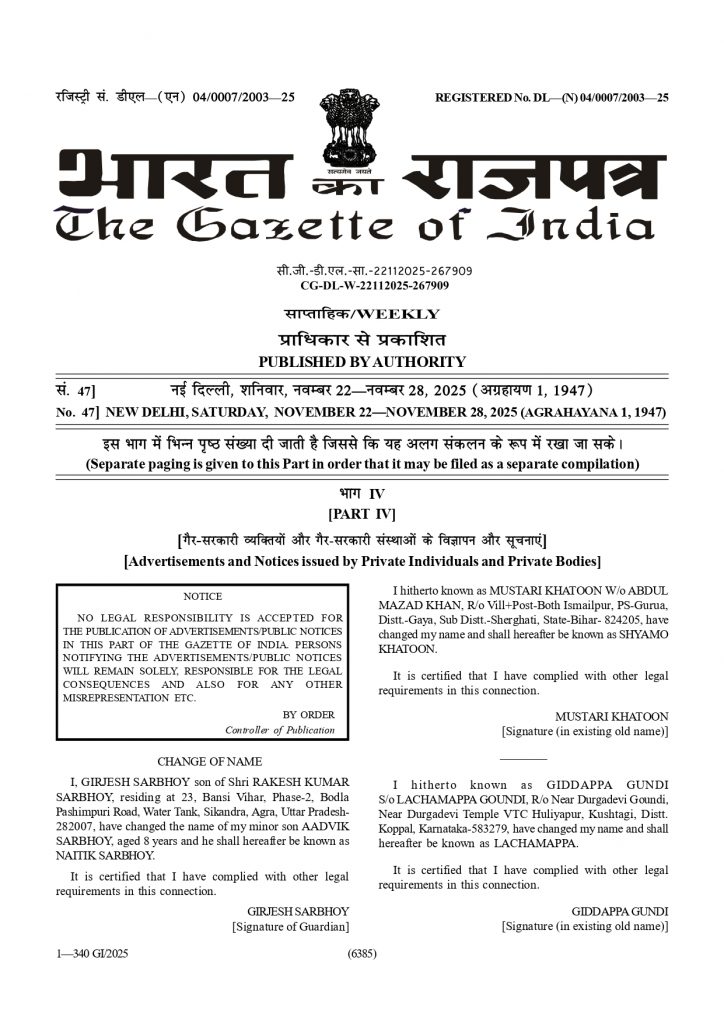
Sample Gazette Notification: What Yours Will Actually Look Like
How to Search and Download Your Published e-Gazette (Free & Official)
Open website egazette.nic.in
Click Search Gazette
Select Ministry/Department → Department of Publication
Select Category → Gazette Notification
Select Part & Section → Part III, Section 4(Part III, Section 4 is for Name Change Gazette notifications)
Fill the date range (from your payment date to 90 days after payment date)
Fill Captcha → Click Search
Your PDF will show in the results. Open and check your name (use Ctrl+F).
Take a printout of three pages (first page, index page where your name appears, and your full notification page).
This is the official e-Gazette copy you will use to update Aadhaar, Passport, PAN, bank accounts, etc.
E-Gazette and Certification
Since 2015, Gazette notifications have been published electronically on egazette.gov.in, and no hard copies have been issued. The e-Gazette is legally valid for almost all purposes, including passports, Aadhaar, banks, etc. No separate certification needed since 2015.
Note: There is still no fully online name change process. The application to the Department of Publication must be sent by post or submitted in person in Delhi. Many websites claiming “100% online” are misleading.
Common Mistakes and Delays
We see applicants skip notarisation, use unsuitable newspapers (affecting acceptance), submit without payment receipt/clippings, or ignore state variations, leading to rejections/returns. We advise: double-check forms, retain all copies, use recommended newspapers, confirm jurisdiction early.
Special Cases
Minors: Guardian affidavit, birth certificate, photos; higher fee (₹1,700); court order if parental dispute. Only one newspaper publication is mandatory, but two are recommended.
After Marriage/Divorce: Support with certificate/decree; no NOC from ex-spouse needed for reversion.
Religious Conversion: Attach proof if available; fee ₹1,100 – ₹ 5,000.
NRIs/Abroad: Higher fees (₹3,500 adult, ₹5,100 minor); possible different submission.
Government Employees: May require departmental NOC; fee ₹1,750 + aliases.
Just Married and Considering a Surname Change? Navigate the Legal Maze Effortlessly with ezyLegal.
Court Judgments on Name Change in India
Court Judgment 1: Name Change (or Retention) After Marriage. Mrs. Vijaya Manohar Arbat v. Kashinath G. Jalgaonkar (Supreme Court of India, 1987). A married woman wished to continue using her maiden surname professionally.
The Supreme Court held that there is no legal compulsion for a woman to adopt her husband’s surname after marriage. The right to retain or change one’s name flows from Articles 19(1)(a) and 21 of the Constitution.
Practical takeaway: If you want to change your surname after marriage, follow the standard affidavit → newspaper → Gazette process. If you want to keep your maiden name, no Gazette is required; just use it consistently.
Court Judgment 2: Reverting to Maiden Name After Divorce. Smt. X v. Y (Mumbai Metropolitan Magistrate Court, 2021 – DV Act maintenance case) After divorce, the wife legally reverted to her maiden surname through affidavit and Gazette notification.
The court explicitly ruled that changing or not changing the surname has no impact on marital status or legal rights, and no permission/NOC from the ex-husband is needed.
Practical takeaway: Your divorce decree + Gazette notification is sufficient to update all documents (Aadhaar, PAN, passport, bank accounts, etc.).
Court Judgment 3: Name Change on Religious Conversion. Perumal Nadar (dead) by LRs v. Ponnuswami (Supreme Court of India, 1971) A person converted from Christianity to Hinduism and adopted a Hindu name.
The Supreme Court held that a bona fide intention to convert is enough; no particular ceremony or ritual is mandatory. The name change was recognised once formally recorded through proper legal process (affidavit + Gazette in modern practice).
Practical takeaway: Attach proof of conversion (certificate from religious body, if available) with your name-change affidavit for smoother acceptance by passport offices and other authorities.
Legal Assistance
Sometimes, hiring a lawyer might pay off, particularly where the case involves minors or where one is entangled in legal issues. Legal practitioners provide personalized recommendations, guarantee the correct provision of documents and stand for you in case of any disputes or legal complications.
This office handles the official Gazette, where all name change notifications are published. The process involves submitting your application, required documents, and fees to this office for review and publication.
Legal Disclaimer
This is for informational purposes only and not legal advice. Procedures/fees vary by state/time; consult official sources (deptpub.gov.in, egazette.nic.in), authorities, or qualified lawyer for your situation. ezyLegal not liable for reliance on this.
ezyLegal‘s Name Change Services in Other States of India
In exploring the complete procedure of legal name change, covering someone’s reasons for changing names to legal framework governing name changes, we have also given essential pre-requisites, documents required and a step-by-step guide on how to change your name.
Changing your name is not an easy task but then following the legal process guarantees all aspects of your new identity will be accepted. Thus, make sure you are fully equipped with all relevant information when you take this step.
As you embark on this journey of self-transformation into another person or set off to open a new chapter in life, wish you all the best.
ezyLegal‘s Name Change Services in Other Cities of India
Disclaimer: The information provided in this article is for general informational purposes only and does not constitute legal advice. Laws, procedures, fees, and timelines may vary depending on the state and individual circumstances. For advice specific to your situation, please consult a qualified legal professional.
Changing your name is a significant life decision that involves navigating complex legal procedures. Why go through it alone when you can have experts by your side? At ezyLegal, we specialize in end-to-end legal services for name changes, ensuring a smooth and hassle-free experience.
Frequently asked Questions
Q1: Is the name change process the same for minors?
Ans1: No, the name change process for minors is different. It requires parental or guardian consent, with the affidavit signed by the guardian. Additional documents needed include the minor’s birth certificate or school ID, a guardian’s undertaking, two self-attested photos of the minor and guardian, and a fee of ₹1,700. Only one newspaper publication is mandatory, though two are recommended for wider acceptance. In cases of dispute between parents or if one parent objects, a civil court order becomes mandatory.
Q2: How long does the process take?
Ans2: The name change process typically takes 6–10 weeks. This includes 1–2 days for affidavit preparation, 3–7 days for newspaper publication, and 30–60 days (or more) for Gazette notification, depending on processing times. Updating various legal documents can add extra time. Delays may occur due to incomplete applications or verification issues, so it’s advisable to start the process early.
Q3: What is the cost involved?
Ans3: The total cost varies by state and the newspapers chosen for publication, generally ranging from ₹2,000 to ₹7,000 for the entire process (excluding fees for updating legal documents like Aadhaar, passport, etc.). Government fees are ₹1,100 for adults and ₹1,700 for minors or religion-related changes. With professional assistance, costs can go higher, up to ₹5,000–₹12,000 in some cases.
Q4: Do I need a witness for the affidavit?
Ans4: Yes, at least one witness is required when getting the affidavit notarized, though typically two witnesses are included in the standard affidavit format. The witness should know you personally and be willing to vouch for your identity.
Q5: How do I change my name legally in India?
Ans5: To change your name legally in India, prepare a notarized affidavit stating the old and new name along with the reason, publish a notice in at least two newspapers (one local and one national), and apply for a Gazette Notification from the Department of Publication. This three-step process makes the change officially recognized.
Q6: What is the procedure to change my name?
Ans6: The standard procedure involves: (1) preparing and notarizing an affidavit on stamp paper with details of the old name, new name, address, and reason; (2) publishing the name change notice in at least two newspapers; and (3) submitting an application (with the affidavit and newspaper clippings) for publication in the Gazette of India.
Q7: Can I change my name for personal reasons?
Ans7: Yes, you can change your name for personal reasons such as preference, numerology, astrology, or any other valid personal motive, as long as you follow the legal process of affidavit, newspaper publication, and Gazette Notification.
Q8: How to change surname after marriage in India?
Ans8: The process is similar to a general name change: prepare a notarized affidavit mentioning the change of surname after marriage, publish a notice in two newspapers, and obtain a Gazette Notification. Many women also simply use their husband’s surname informally without formal change, but for official records, the full legal process is recommended.
Q9: How long does it take to change your name legally in India?
Ans9: The core legal process (affidavit, publication, and Gazette Notification) usually takes 6–10 weeks. Gazette processing can take 30–60 days or longer. Additional time is needed to update documents like Aadhaar, passport, etc.
Q10: What are the costs involved in a name change in India?
Ans10: Costs typically range from ₹2,000 to ₹7,000, covering stamp paper, notary fees, newspaper publication charges, and government Gazette fees (around ₹1,100 for adults). Costs vary by location and newspapers selected. Updating identity documents incurs separate charges.
Q11: How do I change my name in legal documents after a name change?
Ans11: Once you receive the Gazette Notification, use it (along with the affidavit and newspaper clippings) as proof to update your Aadhaar card, passport, Voter ID, PAN card, driving license, bank accounts, educational certificates, and other documents with the respective authorities.
Q12: Can I change my name if I have pending legal issues?
Ans12: Generally, no. You should have no pending criminal cases, legal issues, or court cases against you, as authorities may reject the application or require clearance in such situations.
Adv. Parineeti GN
4.8
4.8 | 85+ User Reviews
Parineeti GN is a legal consultant who prioritises ethical and professional conduct. She graduated with (B.A. and LL.B) from the K.L.E. Society Law College. With more than 8 years of experience in handling legal cases independently. She has the potential to understand and explain complicated legal words in simple terms to clients.
ezyLegal is for the people who are determined to succeed, the goals that motivate them, the loved ones who inspire them. We are for technology that makes it easy, lawyers and accountants who make it seem effortless. For the many people who want to start a business, for the many families who depend on them, for the many ideas they need to protect, we are ezyLegal, with you, every step of the way.









 contact@ezylegal.in
 +91-85 8888 7480